Rodeo 101
Rodeo History
Today’s professional rodeo originated from 16th-century ranches in what is now Southwestern U.S. and Mexico. The essential skills of vaqueros (cowboys) on these working ranches, roping, riding, and handling cattle, evolved into a competitive American sport after the Civil War. Meaning “round up” in Spanish, Rodeo became a spectator sport in the 1880s, officially formalizing with organizations like the Professional Rodeo Cowboys Association (PRCA) forming in 1975.
Following the Civil War, cattle drives and ranching spread, leading to informal contests of skill between cowboys from different ranches. According to some accounts, rodeo was born in 1864 when cowboys from the Hash Knife Ranch competed against cowboys from the Mill Iron Ranch in Deer Trail, Colorado Territory, to settle an argument over who was best at their jobs. However, some credit should go to the Mexican riders who were competing in charreadas many years before rodeos appeared in the United States.
Shows such as Buffalo Bill’s Wild West in the late 19th century helped popularize rodeo skills across the U.S. and Europe. By 1929, the Rodeo Association of America was formed to standardize rules. After World War II, rodeo grew into a major, organized sport with significant prize money.
Rodeo Events
Rodeo is unique in that it is a sport made up of several different events, each with their own style of competition, rules, and rewards.
Barrel Racing
Cowgirls enter the arena on their horse at full speed, quickly rounding each barrel in a cloverleaf pattern and then exiting where they entered.
Breakaway Roping
Cowgirls catch a calf with a lasso, with the rope attached to the saddle horn by a string. The string breaks and the rope releases from the saddle as the calf hits the end of the line, usually in under three seconds.
Bull Riding
Cowboys ride a bucking bull for as long as possible in the most dangerous eight seconds in sports.
Mini Bull Riding
Youth bull riders ride against the clock, attempting to remain on a miniature bucking bull for 8 seconds.
Mutton Bustin’
Aspiring young cowboys and cowgirls get 8 seconds of fame by busting out of the chute aboard a sheep.
Roughstock Events
Events where cowboys ride a bucking bull or bronc. All other events are times events.
Saddle Bronc Riding
In this classic rodeo event, cowboys ride a bucking bronc one handed with a specialized saddle for eight seconds.
Team Roping
Two mounted riders—a header and a heeler—work together to rope and immobilize a steer in the shortest time, often in under six seconds.
Timed Events
Events where speed is everything, including barrel racing, breakaway roping, and team roping. Riders aim for the fastest clean run.
Rodeo Roles
Learn more about the people who make each rodeo possible and safe.
Barrelman
An entertainer who, after a bull ride, uses a barrel to distract the bull and protect the cowboy if needed.
Bullfighter
An athlete who protects the bull rider, after he dismounts or is bucked off, by distracting the bull and directing its attention to the exit gate.
Pickup Man
Mounted cowboys who help riders dismount and escort bucking horses and bulls to the exit gate after a ride.
Rodeo Equipment, Saddles, and Gear
Tools, tack, and apparel that keep the rodeo going.
Box
In a timed event, the area a horse and rider wait before they make a roping or steer wrestling run.
Chaps
Made of leather and often customized by the cowboy. These protect the legs and add flair.
Chute
A pen that holds an animal safely in position before an event.
Flank Strap
A soft strap placed around the flank to encourage the animal to kick out behind itself rather than rear up, which provides a safer, showier ride.
Riggin’
A suitcase-style handhold customized to a rider’s grip and attached to a molded piece of leather that is cinched, with a pad, around the horse’s girth.
Spurs
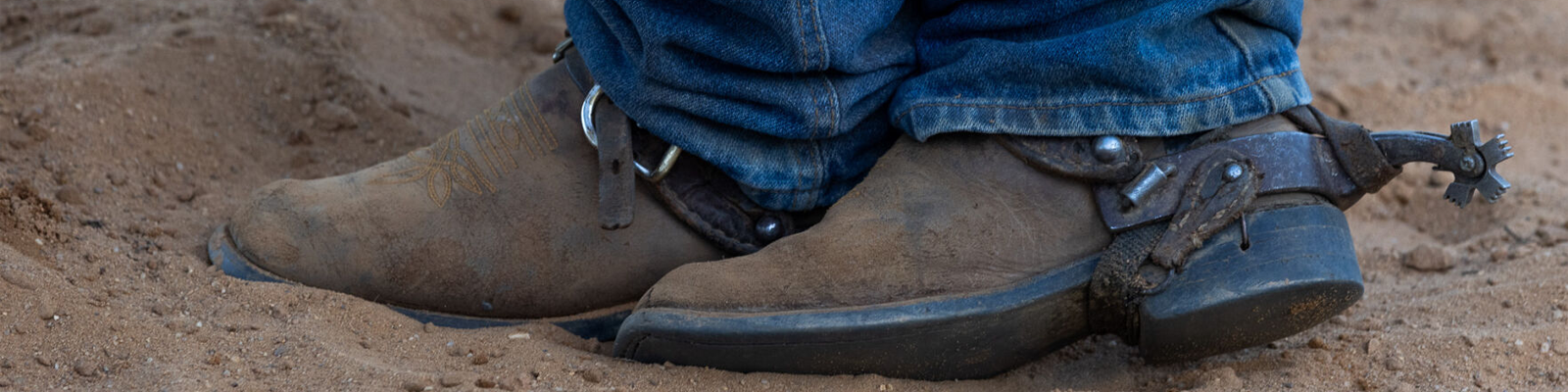
Metal pieces worn on cowboy boots with dulled rowels that do not penetrate the animals’ skin, used to cue the horse or livestock.
Dally
In team roping, each roper, after throwing his loop, wraps the loose rope around his saddle horn – dallies – and the two ropers move their horses to face each other, pulling the ropes taut to stop the clock.
Rodeo Terminology
More rodeo terms you should know, making every moment in the arena easier to follow.
Breaking the Barrier
In timed events, if the roper or steer wrestler leaves the box too soon, failing to give the animal enough of a head start, they are assessed a 10-second penalty.
Bronc
A horse known for bucking.
Bucking
The kicking and twisting motion of roughstock animals.
Cloverleaf
The pattern barrel racers run around the barrels.
Crossfire
In team roping, if the header doesn’t change the direction of the steer before the heeler catches, the run is disqualified.
Free Hand
Roughstock riders must keep one hand free in the air while the other holds the riggin’. Touching the animal, gear, or themselves results in a no score.
Header / Heeler
The two partners in team roping – the header throws the first rope, over the animal’s head or horns, and the heeler throws the second rope to catch the steer’s hind legs.
Hung Up
A dangerous situation when the cowboy’s hand or gear gets caught on the animal and may need help to dislodge his hand so he can get clear.
Mark Out
A dangerous situation when the cowboy’s hand or gear gets caught on the animal and may need help to dislodge his hand so he can get clear.
Nodding
In the roughstock events, a cowboy nods when he is ready for the gateman to open the gate and the ride to begin. In the timed events, a cowboy nods when he is ready for the calf or steer to be released from the chute and get its head start.
No Score
When the cowboy falls off before eight seconds, touches the animal or themselves, or fails to mark out correctly in bronc events.
No Time
When a roper misses, makes an illegal catch, or a barrel racer breaks the cloverleaf pattern.
Re-ride
If a cowboy’s score is affected by equipment failure or a horse or bull that doesn’t buck to performance specifications, the judges may offer the cowboy a clean-slate chance on a different horse or bull.
Tipping a Barrel
In barrel racing, knocking over a barrel adds a five second penalty. If a rider can bump a barrel but keep it upright, no penalty is added.